
A compass card, read in two, three and four dimensions
- north
- east of north
- the fourth direction
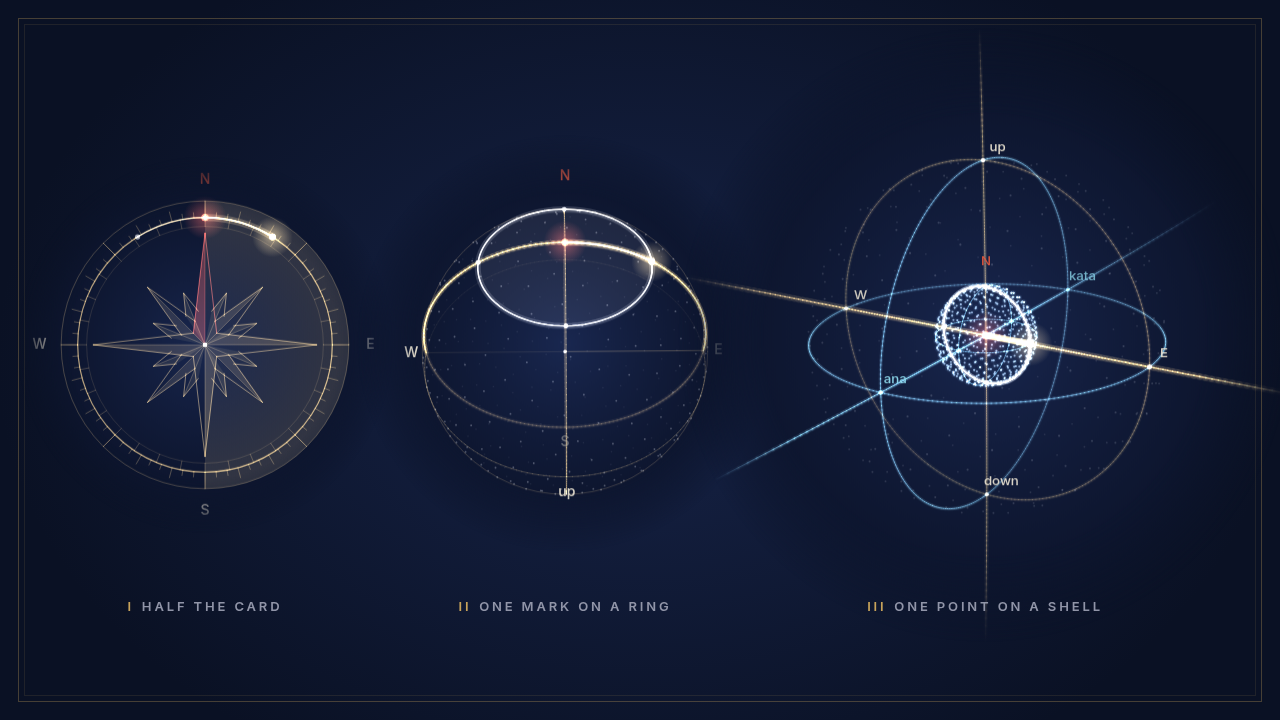
On the cardCompass cardThe printed dial of a compass, marked with north, east, south, west and the points between., north has two neighbours only. Step off it and you're east of it, or west. East of north is half of everywhere that isn't north. The other half is west.
Lift the card. Let the needle tilt and dip. Now north is ringed: a circle of ways to leave, and east is one small mark upon that ring, with up and down and all the slants between.
Add one direction more, at right angles to north and east and up, all three at once. Hinton called its two ends ana and kata. No needle we can make will point along it.
From there, the ring round north becomes a sphere. North sits inside a shell of ways to leave, and east of north is one point on that shell, no more than that, where once it was a half.
From there the compass has no hidden side. The face, the back, the pivot and the brass are all in view together, as a square drawn on a page is to us, inside and edge.
And there a turn is not about a line. It goes about a plane, and two can run at once: north into east, up into ana, neither one disturbing the other's course.
So someone standing there, asked what lies east of north, might say: a little. One direction. You named it as though it were half the world because the card you read from was so thin.
Each plate contains the one before it. The card is the bright brass circle through north and east. The ring is the pale circle on the shell. Plate III is a stereographic projection of the sphere of directions in four dimensions, taken from south: north sits at the centre, south lies at infinity, and a circle that passes through south is drawn as a straight line. Turning up into ana leaves north and east where they are. Turning north into east leaves up and ana where they are. Ana and kata are Charles Howard Hinton's names for the two ends of the fourth direction.
“East of north” is usually read as a direction, a bearing a little clockwise of north. On a compass card it is more than that. It is half of everything the card can point at.
That half does not survive extra dimensions in the form the card suggests. The poem and its three plates follow it through two, three and four dimensions. This essay sets out the geometry behind them, and the one place where I think the poem’s claim needs narrowing.
Two neighbours on the card
A compass card is a circle of bearings. Start at north, move by any small amount, and there are exactly two things you can do: go clockwise or go anticlockwise. North has two neighbours, one on each side.
So the card sorts every departure from north into east or west, with nothing left over. Every bearing between 0 and 180 degrees has some east in it. Every bearing between 180 and 360 has some west. Apart from north and south themselves, the card is divided cleanly in two.
This is a property of circles, not of the Earth. A point on a circle can be left in two ways only. The names east and west are attached to those two ways, which is why they appear to cover everything.
Lift the card and north gains a ring
A real needle does not want to stay in the plane of the card. Left to swing freely in Britain, it points steeply into the ground, roughly 65 to 70 degrees below horizontal. Compass makers counterweight the needle to hold it level. The magnetic field has an up and a down, and the card leaves them out.
Put them back and the bearings become a sphere of directions. North is now a point on that sphere, and the ways of leaving it form a ring around it. East is one mark on the ring. West is the mark opposite. Up and down are two more, a quarter turn round.
Most of the ring is none of these. A departure that is part east and part up has no place on the card. On the sphere it is the ordinary case. Due east, which was one option in two, is now one point on a continuous ring.
The fourth direction
Add a direction at right angles to north, east and up together. Charles Howard Hinton, the British mathematician who first used the word tesseract in 1888, named its two ends ana and kata, after Greek words for up and down. No needle can point along it. The arithmetic does not depend on a needle.
The pattern from the first two steps continues. In two dimensions the neighbours of north are two points. In three they are a ring. In four they are a sphere: a complete shell of directions, each the same small angle from north.
The rule is general. The directions in a space of n dimensions form a sphere of n − 1 dimensions, and the neighbours of any one direction form a sphere of n − 2. Each added dimension gives north one more independent way to be left.
Plate III draws the shell. It is a stereographic projection taken from south, which puts north at the centre and sends south to infinity. East of north is a single gold point on the shell.
No hidden side
Edwin Abbott’s Flatland, published in 1884, made the next point with a square. A being confined to the page meets the square’s edge and nothing else. We look from off the page and see the edge and the interior at once.
The same step up applies to us. An observer with access to the fourth direction would see a brass compass whole: face, back, pivot and the inside of the metal, with no part behind another. Nothing about the compass has changed. The observer has a line of sight we cannot occupy.
Two turns at once
Turning is where four dimensions differ most from three. In our space every rotation has an axis, a line of points that stay still. Leonhard Euler proved in 1775 that any motion of a rigid body about a fixed point amounts to a single rotation about one axis. Combine two rotations and the result is still one.
In four dimensions a rotation leaves a plane still, not a line. Four directions give six planes to turn in, against three in our space and one on the card. They also allow something three dimensions cannot: two rotations in planes that share no direction, running at different rates, each leaving the other’s plane exactly as it was.
Plate III shows this. North turns into east while up turns into ana. Stop either one and the other carries on unchanged.
The half that survives
The poem says east of north shrinks from half the card to one point on a shell. I think that is right about one quantity and loose about another.
The loose part first. Count every direction with some east in it and the answer is a half in any number of dimensions. Half the sphere leans east. So does half of the four-dimensional sphere of directions.
What shrinks is due east as a way of leaving north. It is one option in two on the card, one point on a ring in three dimensions and one point on a shell in four. Something also appears that the card cannot show at all: ways of leaving north with no east or west in them. There are none on the card, two in three dimensions, and a full circle of them in four.
What follows
The more useful conclusion is narrower than the poem’s. East and west never stopped being a fair division of the directions. They stopped being a complete account of how north can be left.
On the card those were the same thing, and that was a fact about the card. An instrument with one degree of freedom reports every change as one of two opposites. If a pair of names appears to divide everything between them, it is worth counting how many directions the instrument can register before accepting the split.
Sources
- Charles Howard Hinton, Wikipedia – first use of tesseract in 1888, and the words ana and kata
- Euler’s rotation theorem, Wikipedia – the 1775 proof and the statement of the theorem
The magnetic dip figure for Britain is approximate and from memory, not from a source opened for this essay.


Leave a Comment